Guide · Channel letters
How much do channel letters weigh? A part-by-part breakdown
- A 24-inch aluminum front-lit channel letter, 5 inches deep, weighs about 6.7 lb (3.0 kg) when you add up its sheet metal, acrylic face and LEDs.
- The returns, the metal sides of the letter, are the heaviest single part: about 36% of an aluminum letter and 61% of a stainless steel one.
- Stainless steel is 2.9 times denser than aluminum, but a finished stainless letter of the same size came out 1.7 times heavier in our calculation.
A 24-inch aluminum front-lit channel letter weighs about 6.7 lb (3.0 kg), and a 48-inch one about 27 lb. A 24-inch stainless steel halo-lit letter weighs about 8.7 lb. Depth and sheet thickness change the figure more than the font, and the power supply is counted once per sign.
The figures below are calculated from the sheet thicknesses we use for channel letters built in our Foshan factory, not guessed from a rule of thumb. The method is at the end of the guide, so you can check it against your own drawings.
How much does a channel letter weigh by height?
All four rows use the same letter, a capital H with a stroke one sixth of its height. A wide letter such as M or W weighs more; a narrow I weighs less.
| Letter height | Aluminum front-lit | Stainless steel halo-lit, 3 in deep |
|---|---|---|
| 12 in | 1.9 lb (0.9 kg), 3 in deep | 3.2 lb (1.5 kg) |
| 24 in | 6.7 lb (3.0 kg), 5 in deep | 8.7 lb (3.9 kg) |
| 36 in | 13.1 lb (5.9 kg), 5 in deep | 16.3 lb (7.4 kg) |
| 48 in | 27.2 lb (12.3 kg), 6 in deep | 30.0 lb (13.6 kg) |
A ceiling of 30 lb per letter is often quoted. In our numbers that holds up to about 48 inches. Above that height, or with a deep return, a single letter goes past 30 lb.
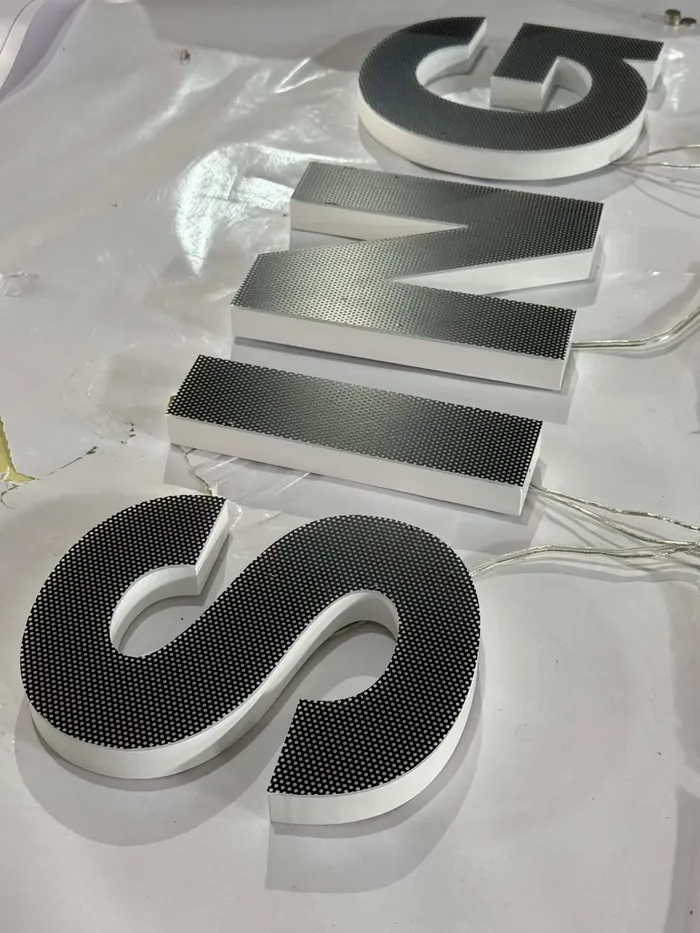
What makes up the weight of a channel letter?
Five parts: the returns, the face, the back, the lighting and the trim cap. This is the 24-inch aluminum front-lit H from the table, part by part.
| Part | Material | Weight |
|---|---|---|
| Returns (sides) | Aluminum .040 in, 5 in deep | 2.4 lb (1.10 kg) |
| Face | Acrylic 3/16 in | 1.9 lb (0.85 kg) |
| Back | Aluminum .063 in | 1.4 lb (0.65 kg) |
| LED modules and wiring | 12 V modules | 0.7 lb (0.30 kg) |
| Trim cap | 1 in plastic trim | 0.4 lb (0.16 kg) |
| Total | 6.7 lb (3.05 kg) |
The returns weigh the most because a letter has far more edge than face. The H has 232 square inches of face but 124 inches of outline, and at 5 inches deep that outline becomes 620 square inches of aluminum.
Depth matters more than most buyers expect. Going from 5 to 7 inches deep adds 40% to the return weight.
Are stainless steel letters 2.5 times heavier than aluminum?
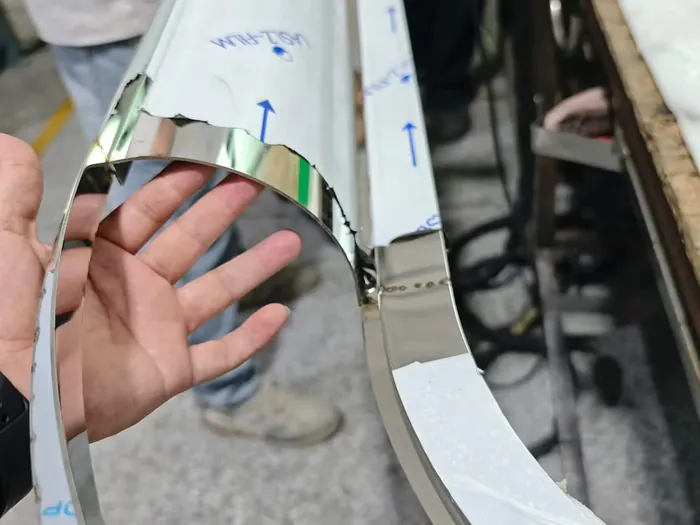
Not as a rule. Grade 304 stainless steel, 06Cr19Ni10 in the Chinese GB/T 20878 designation, has a density of about 7.93 g/cm³ against 2.70 g/cm³ for aluminum, so a sheet of the same thickness is 2.9 times heavier.
Finished letters are lighter than that ratio suggests, because stainless letters are usually made from thinner sheet. Built as a halo-lit letter with 1.0 mm stainless returns and face and a clear 3 mm acrylic back, the same 24-inch H weighs 11.4 lb at 5 inches deep, or 1.7 times the aluminum front-lit letter.
The stainless returns alone are 7.0 lb, 61% of the letter. On a heavy stainless job, return depth is the first thing to look at. Our fabricated stainless steel letters are usually 2 to 3 inches deep for this reason.
How do you estimate sign letter weight before it is built?
Add up the weight of each sheet, then add the lighting. It is the basic length × width × depth × density sum, applied part by part.
- Face: face area × weight of the face sheet per square foot.
- Returns: outline length × depth × weight of the return sheet per square foot.
- Back: face area × weight of the back sheet per square foot.
- Lighting and trim: about 1 lb per 24-inch letter for LED modules, wiring and trim cap, scaled with size.
- Power supply: count it once per sign, not per letter.
| Sheet | Thickness | Weight per sq ft |
|---|---|---|
| Cast acrylic | 3/16 in (4.8 mm) | 1.16 lb |
| Cast acrylic | 1/2 in (12.7 mm) | 3.09 lb |
| Aluminum | .040 in (1.0 mm) | 0.56 lb |
| Aluminum | .063 in (1.6 mm) | 0.89 lb |
| Aluminum | .080 in (2.0 mm) | 1.13 lb |
| Stainless steel 304 | 0.039 in (1.0 mm) | 1.62 lb |
Our standard build uses .040 or .063 inch aluminum returns, 3 to 5 inches deep, with 3/16 inch acrylic faces. Larger letters step up a gauge, which is why the 48-inch row uses .063 inch returns and an .080 inch back.
How much do solid and hollow acrylic letters weigh?
A solid acrylic letter is heavy for its size. The 24-inch H cut from 1-inch cast acrylic weighs 10 lb, more than the same letter built as an aluminum channel letter with lights inside. At 12, 36 and 48 inches the same solid H weighs 2.5, 22.4 and 39.9 lb.
A buyer recently asked us about two 26-inch faceted acrylic letters for an office wall, as light as possible. Cut solid with deep facets, each would weigh roughly 8 to 15 lb depending on the letter. Built hollow from 5 mm acrylic shells, the same letters come down to about 3.5 to 4.5 lb, a saving of 60 to 70%. The trade-off is visible: a hollow letter has seams, and its facets cannot be cut as deep.
How does letter weight affect shipping?
For channel letters, the size of the crate usually decides the freight cost, not the weight. Air freight is charged on volumetric weight when it is higher than the real weight, and the common IATA ratio is 6,000 cm³ per kg.
A crate of 120 × 80 × 40 cm counts as 64 kg for air freight, even if the letters inside weigh 20 kg. That is why we build export crates to the size of each order and nest letters where the shapes allow. For larger orders sea freight is usually cheaper. Sign companies ordering from us can read how we pack and ship on our white label sign fabrication page.
How did we calculate these weights?
Each figure adds up the area of every sheet in the letter multiplied by its weight per square foot, plus an allowance for LEDs, wiring and trim cap. Densities used: cast acrylic 1.19 g/cm³, aluminum 2.70 g/cm³, stainless steel 304 7.93 g/cm³.
What this guide does not cover yet: we have not put these letters on a scale for this edition, and we have not included raceways, backer panels, neon or letters taller than 48 inches. We will add weighed figures from our factory floor when they are ready. The engineering figures were reviewed by Ting Fu, Engineering Manager.
Need a weight for your own drawing? Send it through our sign quote request form and we will include the calculated weight per letter with the quote.