Guide · Lightbox signs and channel letters
Channel letters or a lightbox? One sign space built three ways
- On a 24 × 79 in (600 × 2000 mm) sign space, a five-letter name can be about 18.7 in tall, but a 12-letter name on one line only about 7.5 in.
- Built three ways for that space, the sign weighs about 44 to 55 lb as a lightbox, 31 to 40 lb as front-lit letters on a panel and 40 to 49 lb as halo-lit stainless steel letters, by our calculation.
- A lightbox needs only a new face when the name or logo changes; channel letters have to be rebuilt letter by letter.
Channel letters are separate lit letters fixed to a wall or panel; a lightbox is one lit cabinet with a printed or routed face. On the same sign space, a lightbox fits more logo and text, while channel letters look more dimensional. With a long name, the letters come out smaller than most buyers expect.
A buyer recently asked us for one LED sign for the roof of their building: 600 × 2000 mm, no artwork yet, and a request for ideas. This guide answers that question with numbers, using the way we build lightbox signs in our Foshan factory and channel letters on the same floor.
What is the difference between channel letters and a lightbox sign?
Channel letters are built one letter at a time. A lightbox is one cabinet, and everything on the sign sits on its face.
| Part | Channel letters | Lightbox |
|---|---|---|
| Body | Aluminum or stainless steel returns around each letter, usually 3 to 5 in deep | One aluminum or galvanized steel cabinet, welded and painted |
| Face | 3/16 in acrylic cut to each letter, or metal on halo-lit letters | Acrylic, printed film, or routed metal with push-through acrylic |
| Light | LED modules inside each letter | LED modules lighting the whole face |
| Changing the name | New letters | New face, same cabinet |
Channel letters can also be built without lights, as flat-faced metal letters. Lit or unlit, each letter is its own part.
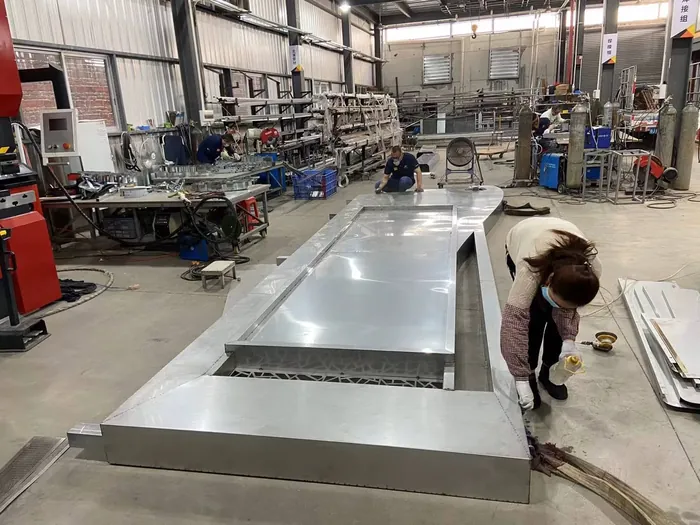
What does one 24 × 79 in sign space look like built three ways?
We took the space from that request, 24 × 79 in (600 × 2000 mm), and worked out three builds for a two-word, 12-letter name.
| Build | Main parts | Weight (calculated) |
|---|---|---|
| Lightbox | 79 × 24 in cabinet, 5 mm acrylic face, 1.5 mm aluminum sides and back, LEDs, power supply | 44 to 55 lb (20 to 25 kg) |
| Front-lit letters on a panel | 12 aluminum letters 8.5 in tall, 4 mm aluminum composite panel, frame | 31 to 40 lb (14 to 18 kg) |
| Halo-lit letters on a panel | 12 stainless steel letters 8.5 in tall, 1.0 mm sheet, aluminum panel | 40 to 49 lb (18 to 22 kg) |
The lightbox is the heaviest because its face and back cover the whole space. The front-lit letters are the lightest; most of their weight is the panel behind them. Stainless steel halo-lit letters land in between, because stainless sheet is heavy but only the letter outlines use it.
For a part-by-part method you can apply to your own letters, see our guide to how much channel letters weigh.
Why does the length of your name set the letter height?
Because the letters have to fit across the width as well as the height. On a short name the height of the space is the limit; on a long name the width runs out first.
| Name | Layout | Largest letter height |
|---|---|---|
| 5 letters | One line | 18.7 in (475 mm) |
| 8 letters | One line | 11.7 in (297 mm) |
| 12 letters, two words | One line | 7.5 in (190 mm) |
| 12 letters, two words (7 + 5) | Two lines | 8.5 in (217 mm) |
A five-letter name can almost fill the 24 in height. A 12-letter name on one line drops to 7.5 in, less than half. Splitting it over two lines only gains about one inch, because two lines have to share the height.
For a long name there are three ways out: put the name in a lightbox with the logo, make the logo the lit element and the name smaller, or ask for a longer sign space. A bigger panel of the same proportions helps less than most buyers expect.

How far away can people read each sign?
Reading distance grows with letter height: double the height and the sign reads from roughly twice as far. That is why the name-length table matters more than the build type when the sign has to be seen from the street.
A lightbox can use the full face for a large logo, so a long-named business often reads better from a distance as a lightbox. Contrast also counts: light letters on a dark face, or a bright halo against a pale wall, read further than low-contrast colors.
What changes the price of each build?
We do not publish prices, because every sign is built to its drawing. These are the factors that move the quote.
- Channel letters: the number of letters, letter height, stroke complexity (script takes longer than block capitals), return material and lighting type.
- Lightbox: cabinet size and shape, face type (printed, routed metal with push-through acrylic) and whether it is single or double-sided.
- Later changes: a lightbox face can be replaced on its own; changing a name in channel letters means new letters.
Which holds up better outdoors, including coastal and tropical sites?
Both last outdoors when the details are right: outdoor letters and cabinets need drainage and sealed joints, and the power supply must be rated for outdoor use. The LED modules and power supplies we fit are UL certified.
Near the sea, ask for a corrosion-resistant build: aluminum, or a marine grade of stainless steel instead of standard 304. An IP rating covers water and dust; it does not cover salt spray. For halo-lit letters, see our fabricated stainless steel letters.
What comes in the crate when a sign ships from our factory?
We build single signs as well as multi-site rollouts; the minimum order is 1 piece. Every sign is switched on and tested before packing. The crate goes out with an installation drawing, a mounting frame drawing, a wiring diagram, spare LED modules and anchors, and a power supply for the mains voltage at your site.
A local electrician or sign installer fits it from those drawings. On a roof, have them check the frame and fixings against your building and wind conditions, and check your landlord's and city's sign rules before you order.
How to choose: three questions
- Indoors or outdoors? Outdoors needs drainage, sealing and an outdoor power supply on either build.
- Do your landlord or city rules limit the sign? Some shopping centers ask for individual letters; some allow cabinets only in set positions.
- Just a name, or a detailed logo or menu? A short name suits channel letters. A multi-color logo or a long name usually suits a lightbox.
How did we work out these numbers?
Letter heights assume a 2 in (50 mm) margin on every side, each letter plus its spacing taking about 0.8 of its height in width, a word space of 0.4 and a line gap of 0.3 of the letter height. Weights add up the area of each sheet multiplied by its density (acrylic 1.19, aluminum 2.70, stainless steel 7.93 g/cm³), plus frame and lighting.
What this guide does not cover yet: these three builds have not been put on a scale or photographed side by side, and we have not measured their power use. Wind loads and local sign codes depend on your site. The figures were reviewed by Ting Fu, Engineering Manager.
Have a sign space and a name? Send the size and a photo of the wall through our sign quote request form and we will lay out the options for you.